

An audit report template provides a structured way to document the results of an audit, summarize findings, and communicate recommendations to management, clients, departments, or other stakeholders. Instead of creating an audit report from scratch, you can use a ready-made format to organize important information consistently and professionally.
Audit reports are commonly used for financial audits, internal business audits, compliance reviews, quality audits, operational assessments, project audits, and other evaluation activities. A well-organized report makes it easier to identify areas that meet requirements, document issues, and recommend corrective actions.
What Is an Audit Report?
An audit report is a formal document that presents the results of an audit or review. It generally explains the purpose and scope of the audit, the procedures or areas reviewed, significant findings, supporting observations, and recommendations.
The exact contents depend on the type of audit. For example, an internal business audit may focus on company procedures and controls, while a quality audit may evaluate processes against specific standards or requirements.
Using an audit report template in Word or Excel can make the reporting process more organized and save time when preparing recurring audits.
What Does an Audit Report Template Include?
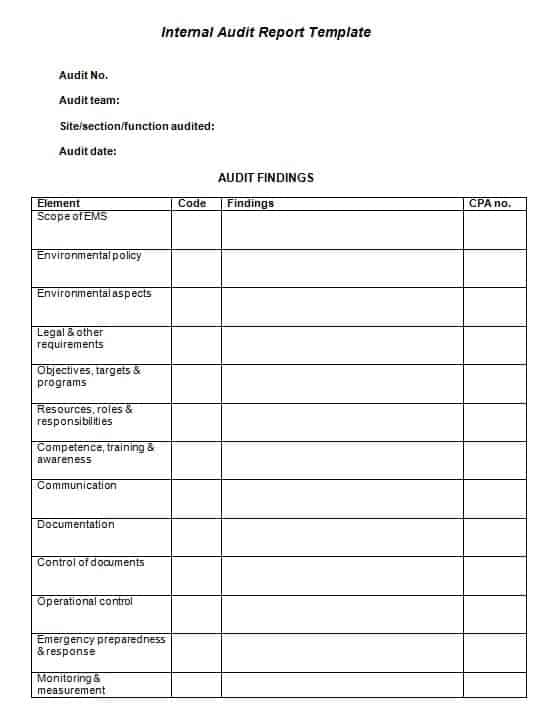
A useful audit report format can include sections such as:
- Audit title and report number
- Organization or department being audited
- Audit date and reporting period
- Auditor or audit team
- Audit objectives
- Scope of the audit
- Areas, processes, or records reviewed
- Audit methodology
- Findings and observations
- Nonconformities or identified issues
- Evidence or supporting information
- Risk or priority level
- Corrective action recommendations
- Responsible person or department
- Target completion date
- Overall conclusion
- Auditor comments and approval
You can modify these sections according to the requirements of your organization and the type of audit being performed.
Benefits of Using an Audit Report Template
A free audit report template can provide a consistent starting point for documenting audit results. A standardized format helps auditors organize findings in a logical sequence and makes reports easier for readers to review.
Templates are particularly useful when an organization performs audits regularly. Instead of designing a new report for every assignment, the same basic structure can be reused while updating the relevant dates, findings, evidence, and recommendations.
A structured report can also make it easier to follow up on corrective actions. When findings are clearly documented alongside responsible departments and expected completion dates, management can more easily track outstanding issues.
Audit Report Template in Word
A Word audit report template is useful when the report requires detailed written explanations. You can edit headings, paragraphs, tables, findings, recommendations, and other sections directly in Microsoft Word.
Word is especially suitable for formal reports that need narrative descriptions, signatures, supporting documentation, or a professional printable layout.
Audit Report Template in Excel
An Excel audit report template can be useful when the audit contains multiple findings, action items, scores, dates, or status fields. Spreadsheet-based reports make it easier to organize information into rows and columns and can be adapted for tracking corrective actions.
For recurring audits, Excel can also provide a convenient structure for maintaining lists of findings and follow-up activities.
How to Prepare an Audit Report
Start by identifying the audit objective, scope, date, and areas being reviewed. Record the procedures performed and evidence examined during the audit. Then document significant findings clearly and objectively.
Each finding should explain the issue without unnecessary or unsupported assumptions. Where appropriate, include the relevant evidence, requirement, risk, and recommended corrective action.
Finally, summarize the overall results and identify follow-up actions. Before distributing the report, review it for accuracy, consistency, and completeness.
An audit report template is therefore a practical starting point for creating clear, organized, and professional audit documentation while allowing the format to be customized for different audit requirements.
Download Internal Audit Report template:

How to Use These audit report template Effectively
A defensible audit report links every conclusion to scope, criteria, evidence, risk, and a trackable corrective action. The resource is designed for internal auditors, compliance teams, nonprofit boards, quality managers, and small businesses. Before editing, decide who will complete the document, who will review it, and what final record must be retained. That small planning step prevents a visually polished file from becoming difficult to use in practice.
Choose the Right Version for the Task
Start with the layout that matches the real workflow rather than choosing only by appearance. Common applications include internal control reviews, process audits, financial checks, compliance reviews, and follow-up reporting. A short, frequently used document should be easy to scan and complete. A formal record may need more instructions, approvals, references, and space for supporting details.
Download a clean copy before making changes. Rename the working file with a meaningful project, client, class, or reporting-period reference. Keep an untouched master so future versions do not inherit old names, amounts, dates, or confidential information.
Important Details to Include
Review every label before distribution. Depending on the selected layout, useful information normally includes:
- scope and objectives
- criteria and methodology
- evidence reviewed
- findings
- risk rating
- recommendations, owners, and deadlines
Remove fields that do not serve a genuine purpose and add any information required by your organization. Clear labels are more useful than dense instructions. If several people will use the file, include a short example or completion note wherever a field could reasonably be interpreted in more than one way.
A Reliable Customization Workflow
- Define the purpose. Write one sentence explaining the decision, transaction, activity, or record the document must support.
- Confirm the audience. Adjust vocabulary and instructions for the person completing the form and the person reviewing it.
- Edit the structure. Keep the relevant sections, remove unused placeholders, and add approval or reference fields only where needed.
- Test the document. Complete one sample with realistic information to check spacing, calculations, page breaks, and print quality.
- Control the final version. Add a revision date or file version, protect formulas where appropriate, and save completed records securely.
Quality and Accuracy Checks
Check spelling, dates, numbering, totals, names, and terminology before using the finished file. Make sure table columns remain readable after editing and that important text does not move onto an unexpected page. For Excel files, test formulas with several values, including zero, discounts, and unusually large figures. For Word files, review both the editing view and a PDF or print preview.
The most important issue to avoid is presenting conclusions without evidence or failing to distinguish observations from material findings. Use consistent formats for dates, currency, units, and names. If the document affects money, employment, legal rights, health, safety, or official records, have an authorized person review it before release. A downloadable template is a starting point and should be adapted to applicable policies and local requirements.
Saving, Sharing, and Maintaining the File
Use a predictable filename and store completed copies in a location with appropriate access controls. Avoid emailing editable files containing sensitive information when a secure system is available. If signatures are needed, state whether typed, handwritten, or approved electronic signatures are accepted. Archive final copies separately from blank masters.
Review the template whenever the process, responsible person, pricing, policy, regulation, or branding changes. Periodic review keeps the document accurate and reduces the chance that staff continue using an outdated copy. These practical controls make the template easier to reuse and more dependable as an operational record.
Frequently Asked Questions
1. What is an audit report template?
An audit report template is a pre-structured document used to organize audit objectives, scope, findings, evidence, recommendations, conclusions, and follow-up actions.
2. What should an audit report contain?
Common sections include audit information, objectives, scope, methodology, findings, observations, evidence, recommendations, corrective actions, and conclusions.
3. Can I edit an audit report template in Word?
Yes. A Word-based audit report template can normally be customized by editing its headings, tables, text, dates, findings, and other report sections.
4. Is an audit report template available in Excel?
An Excel format can be useful for audits involving multiple findings, action items, dates, priorities, and follow-up status.
5. What types of audits can use an audit report template?
Templates can be adapted for internal audits, financial reviews, quality audits, compliance audits, operational audits, project audits, and other organizational assessments.
6. How do I write an audit finding?
An audit finding should clearly describe the observed condition and relevant evidence. Where applicable, it can also identify the applicable requirement, potential impact, and recommended corrective action.
7. What is the difference between an audit report and an audit checklist?
An audit checklist helps guide the auditor through items or requirements to review. An audit report documents the results, findings, observations, and conclusions after or during the audit.
8. Can I customize the audit report format?
Yes. The sections can be changed to match the organization’s audit procedures, industry requirements, reporting standards, and the type of audit being performed.


